Portfolio #2
S&P 500 Repair Strategy: An Income-Focused Investment Strategy
Tell Me More
S&P 500 Repair Strategy: An Income-Focused Investment Strategy
Designed for investors seeking current income while maintaining the potential for long-term capital appreciation.
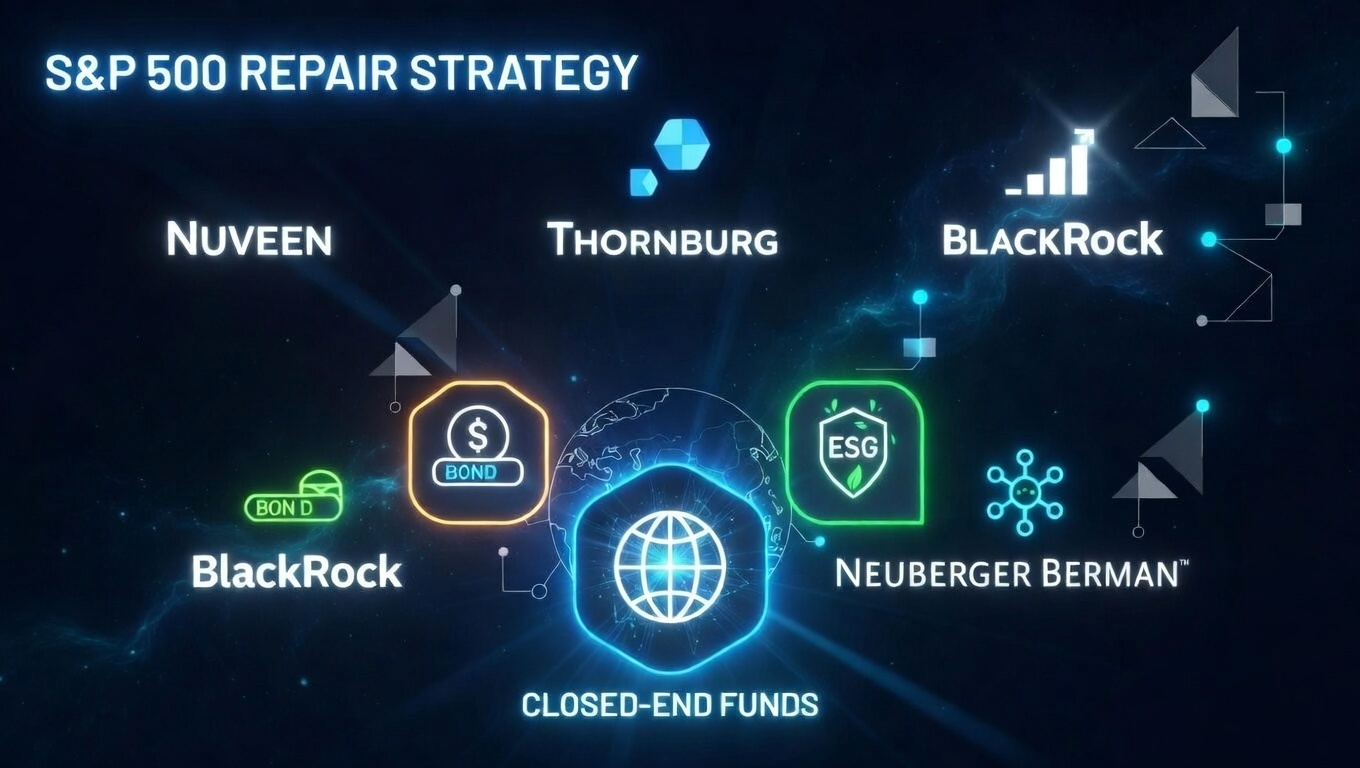
The S&P 500 Repair Strategy is an income-focused investment portfolio created by Z Advisory Innovations in September 2022.
The strategy uses carefully selected closed-end funds and diversified investment exposures with the goal of generating current income while maintaining opportunities for long-term capital appreciation.
Income First. Growth Second.
Some investors reach a point where generating income from their portfolio becomes increasingly important.
The S&P 500 Repair Strategy was designed with that objective in mind. Rather than focusing primarily on aggressive capital appreciation, the strategy emphasizes income-producing investments while maintaining exposure to assets that may participate in long-term market growth.
The portfolio may include exposure to U.S. equities, fixed income, global dividend strategies, technology and other investment themes depending on market conditions and portfolio objectives.
Why We Call It the Repair Strategy
Market declines can create challenges for investors, particularly when withdrawals are being taken from a portfolio.
They can also create reinvestment opportunities.
When investment prices decline, distributions that are reinvested may purchase additional shares at lower prices. Over time, this can potentially improve an investor's cost basis and increase the number of income-producing shares owned.
This is the concept behind the term Repair Strategy.
It is not a guarantee that market losses will be recovered. Closed-end fund prices may continue declining, distributions may be reduced, and reinvestment does not eliminate investment risk.
Closed-End Funds and Income
Closed-end funds can provide access to professionally managed portfolios across multiple asset classes and investment strategies.
Depending on the individual fund, distributions may be generated from dividends, interest income, capital gains, return of capital or a combination of sources.
Closed-end funds also trade in the market and may trade above or below the value of their underlying assets.
Our investment process evaluates factors including portfolio composition, distribution characteristics, valuation, manager experience and how an investment fits within the broader strategy.
Diversification Beyond a Traditional Equity Portfolio
The Repair Strategy is designed to provide exposure beyond a traditional large-cap equity portfolio.
Depending on portfolio positioning, this may include:
• U.S. equity exposure
• Fixed-income investments
• Global dividend strategies
• Technology and infrastructure
• Income-oriented investments
• Other diversified investment themes
The objective is to combine current income with broader diversification and participation in long-term investment opportunities.
Who May Consider the Repair Strategy?
The strategy may be appropriate for investors who:
• Place a high priority on current portfolio income.
• Want continued potential for capital appreciation.
• Have a medium- to long-term investment horizon.
• Can tolerate fluctuations in portfolio value.
• Understand the risks associated with closed-end funds and income-oriented investing.
The strategy is not appropriate for every investor.
Understanding the Risks
All investments involve risk, including the possible loss of principal.
Closed-end funds can trade at premiums or discounts to their net asset value, and those discounts may widen during periods of market stress.
Distributions are not guaranteed and may be reduced or discontinued. Some distributions may include return of capital, which can reduce an investor's cost basis.
Fixed-income investments are subject to interest-rate and credit risk, while equity investments remain exposed to market volatility.
Reinvesting distributions can increase the number of shares owned but does not guarantee recovery from market losses.
A Disciplined Investment Process
Z Advisory Innovations evaluates investments based on the role each position is intended to serve within the overall portfolio.
For the S&P 500 Repair Strategy, the primary objective is current income, followed by the opportunity for long-term capital appreciation.
Portfolio allocations may change as valuations, market conditions, income opportunities and risks evolve.
Before recommending the strategy, we evaluate the investor's objectives, risk tolerance, income needs, investment time horizon and broader financial circumstances.
Explore our investment strategies or contact Z Advisory Innovations to determine whether the S&P 500 Repair Strategy fits your investment objectives.